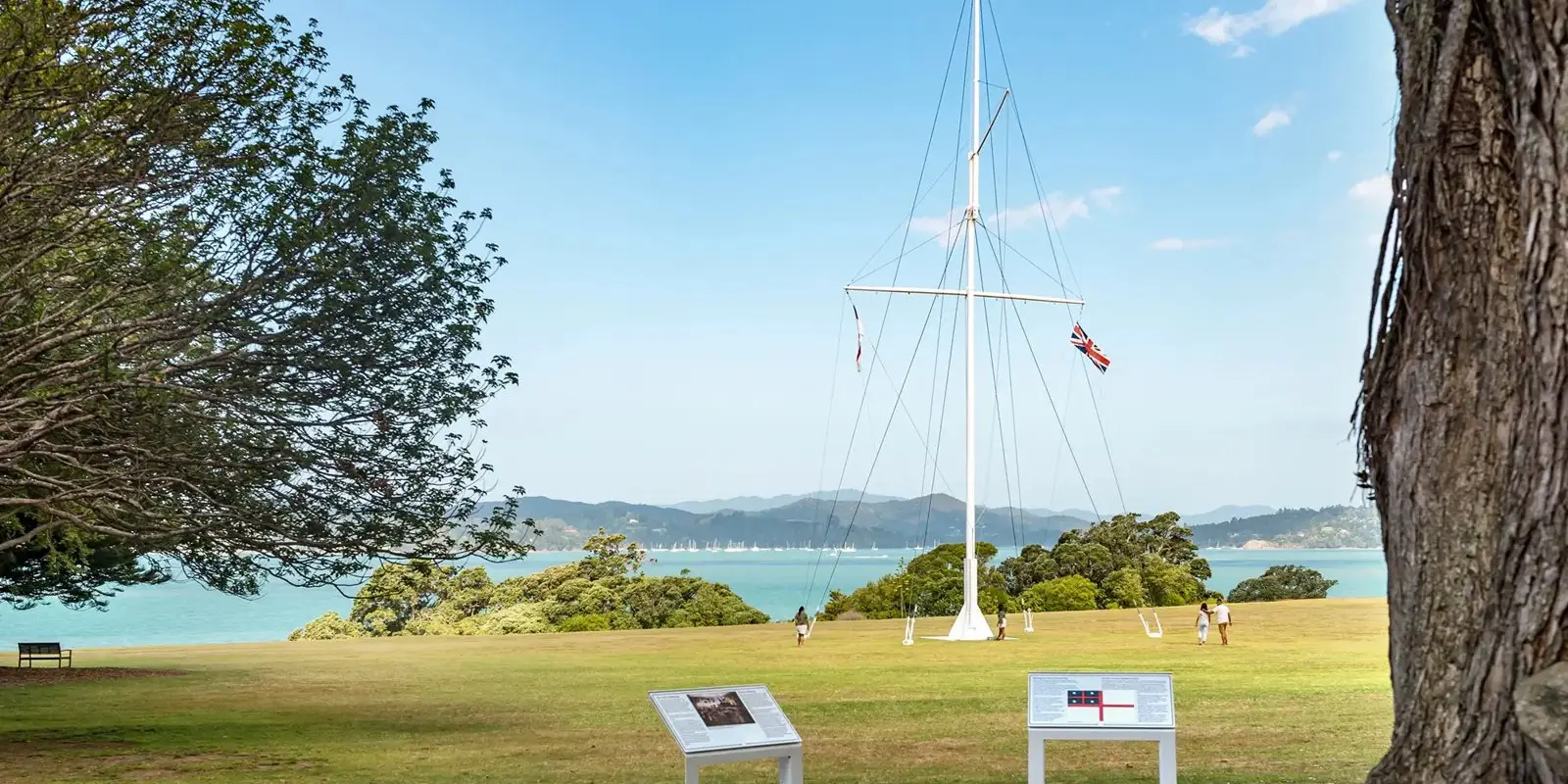
Waitangi Day, 6 February, is New Zealand's national day. The Waitangi Treaty Grounds in the Bay of Islands, where Te Tiriti o Waitangi was first signed in 1840, holds a free festival on the day, but all its buildings are closed. A free shuttle runs from Paihia in summer, and the Grounds are 2 km from town.
On this page
Key facts
- When
- Saturday 6 February 2027
- Where
- Waitangi Treaty Grounds, Bay of Islands
- Cost
- Free festival on Waitangi Day
- Buildings
- All museums and buildings closed on 6 February
- Shuttle
- Free from the Maritime Building, Paihia (1 October to 30 April)
- From Paihia
- 2 km: about 25 minutes' walk
- From Auckland
- About 230 km and 3 hours 15 minutes' drive (estimate)
- Week before
- Opening hours may change from 1 to 5 February
What it is
Waitangi Day is New Zealand’s national day, a public holiday on 6 February each year. It marks the signing of Te Tiriti o Waitangi, the Treaty of Waitangi, between Māori rangatira (chiefs) and the British Crown at Waitangi on 6 February 1840.
The Waitangi Treaty Grounds in the Bay of Islands describe themselves as a place for all New Zealanders, where much of the country’s history was shaped. It was here that the first national flag was chosen in 1834; He Whakaputanga, the Declaration of Independence of New Zealand, was signed in 1835; and the Treaty was given its finishing touches in the Treaty House before being read to the chiefs on 5 February 1840. Northern Māori in particular regard He Whakaputanga as the parent document of Te Tiriti.
The Treaty House was New Zealand’s first residence for a British Government official. In 1932, Governor-General Lord Bledisloe and Lady Bledisloe bought the house and surrounding land and gifted the estate to the people of New Zealand as a national memorial to the Treaty.
What to expect
On Waitangi Day there is a free festival at the Treaty Grounds. It is the country’s best-known commemoration and draws big crowds, so expect busy roads and a lively, sometimes political atmosphere. Check the official site and local news for the 2027 programme closer to the day.
All buildings are closed on 6 February, and opening hours may change from 1 to 5 February because of Waitangi Week commitments. To see Te Kōngahu Museum of Waitangi, the Treaty House and Te Whare Rūnanga, visit on another day.
Who it suits
Anyone who wants to understand modern New Zealand. Visitors from overseas are welcome, but come with an open mind: the day celebrates the nation, and it is also when Māori and other New Zealanders debate the Treaty and its promises.
Getting there
- From Auckland: follow SH1 north to Whangārei (165 km), then follow signs to Kawakawa (60 km) and the Bay of Islands and Paihia (15 km). Allow about 3 hours 15 minutes (an estimate), and longer on the holiday.
- Fly: Bay of Islands (Kerikeri) Airport is about 25 minutes’ drive from Paihia (an estimate).
- From Paihia: the Grounds are 2 km away, an easy 25-minute walk. Follow the waterfront road through the roundabout and over the one-lane bridge.
- Free shuttle: from 1 October to 30 April (except 25 December), a complimentary shuttle runs between the Maritime Building in Paihia and the Treaty Grounds, first come, first served.
- Parking: free outside the main entrance and on Tau Henare Drive. Accessible parking is in the main car park.
Where to stay
Stay in Paihia so you can walk or take the shuttle. Kerikeri and Russell are other options. Waitangi Day falls in peak summer, so book early. Our Bay of Islands guide covers where to stay.
Accessibility
The 16-hectare Grounds include boardwalks, concrete paths, tracks, beaches and lawns, which can be hard with restricted mobility. Wheelchairs (maximum user weight 100 kg) and ramps are available, and the official Access Guide has detailed information.
What to bring
Sunscreen, a hat, water and comfortable walking shoes. February is one of the warmest months in Northland.
Make a trip of it
Come back another day to tour the Treaty Grounds properly, then explore the islands by boat: see our Bay of Islands guide and 10-day North Island road trip.
FAQ
Is the Waitangi Day festival free?
Can I visit the museums on Waitangi Day?
How do I get to the Treaty Grounds from Paihia?
Is there parking?
Is the site accessible?
Sources
Last checked 11 November 2026 against the organiser's own pages