You can drive in New Zealand on a current overseas licence or international driving permit; if your licence is not in English, carry an accurate English translation. If you arrived on or after 1 November 2026, your overseas licence is valid for 12 months. Drive on the left, overtake only with 100 m of clear road ahead, give way at one-lane bridges when the red arrow is yours, and treat signed speed limits as the maximum. The adult alcohol limit is 250 mcg per litre of breath and zero for drivers under 20.
On this page
Key facts
- Licence
- Current overseas licence or international driving permit, plus English translation if needed
- How long it lasts
- 12 months if you last arrived on or after 1 November 2026 (NZTA)
- Side of the road
- Keep left, including at every intersection
- Open road maximum
- Up to 100 km/h where signed; 90 km/h if over 3,500 kg or towing
- Alcohol limit
- 250 mcg per litre of breath (over 20); zero for under 20s
- Phone
- Hand-held use banned: $150 fine and 20 demerit points
- Speeding fines
- $30 (up to 10 km/h over) to $630 (46 to 50 km/h over)
- Checked
- As at November 2026
New Zealand looks easy to drive on a map. Then you meet your first one-lane bridge, a gravel detour, a line of campervans on a mountain pass and a road sign that says 100 km/h on a road you would not take at 60. Most visitors drive here without trouble, but the same handful of rules and habits catch people out every year.
This guide covers the licence rules (which changed on 1 November 2026), the road rules that differ from home, speed and alcohol limits, fines and how to plan realistic drive times. Rules and fines are from NZTA, NZ Police and the Land Transport (Road User) Rule, as at November 2026.
Licence rules
According to NZTA, to drive in New Zealand you need a current and valid overseas driver licence or an international driving permit (IDP). You must carry it whenever you drive. If your licence or permit is not in English, you must also carry an accurate English translation.
How long you can use it changed on 1 November 2026:
| You last arrived in New Zealand | You can drive on your overseas licence for |
|---|---|
| Before 1 November 2026 | Car licence: 18 months. Truck or motorcycle: 12 months |
| On or after 1 November 2026 | Car, truck or motorcycle: 12 months |
After that you need a New Zealand licence. For most holidaymakers, 12 months is plenty, but working holiday visitors who arrive now should note the shorter limit.
Rental companies add their own conditions, such as minimum age and how long you must have held your licence. Our car rental guide compares those terms across the major companies.
Keep left and give way
Drive on the left. NZTA’s booklet for visitors puts it simply: always drive on the left, keep left at every intersection and every time you pull out onto a road, do not cut corners, and do not cross the centre line unless you are passing or turning. Some narrow roads have no line markings at all.
Give way rules at intersections come from clause 4.2 of the Land Transport (Road User) Rule. The ones that matter for visitors:
- If you are turning, you give way to traffic that is not turning.
- If you are turning right, you give way to an oncoming vehicle turning left.
- At a T-intersection, traffic on the road that ends gives way to all traffic on the continuing road, including vehicles turning right into your road.
- At a stop sign, come to a complete stop, then give way to all traffic. At a give way sign, give way to all traffic except vehicles facing a stop sign.
- At roundabouts, go clockwise and give way to traffic on your right.
Signal for at least three seconds before turning, changing lanes, or pulling in or out. When parking, face the direction of traffic on your side of the road; NZTA says you can be fined or towed for facing the wrong way (on a one-way street you may park on either side).
Insider tip: the moment visitors drift onto the wrong side is not on a busy highway, it is pulling out of a car park or petrol station onto an empty road. Say “keep left” out loud for the first few days, and get your passenger to say it too.
Speed limits and overtaking
Speed limit signs show the maximum, not a target. NZTA reminds drivers to go slower in rain, fog or on winding roads, and yellow curve signs show a safe, comfortable speed for the bend ahead. If you are driving a vehicle over 3,500 kg or towing a trailer, boat or caravan, your limit is 90 km/h even where the road is signed 100 km/h.
Most roads have one lane each way. NZTA’s overtaking rules:
- Use passing lanes where you can, and be patient until you reach one.
- You need 100 m of clear road ahead for the whole time you are passing, including after you finish.
- A solid yellow line on your side means it is too dangerous to overtake. A double yellow line means no one may overtake.
- Never overtake on or near a corner.
- If you are slow and a queue builds behind you, pull over safely and let them past. This one matters in a campervan.
Leave at least 1.5 m when passing a cyclist, and slow down for animals on the road without sounding your horn.
Rural roads and one-lane bridges
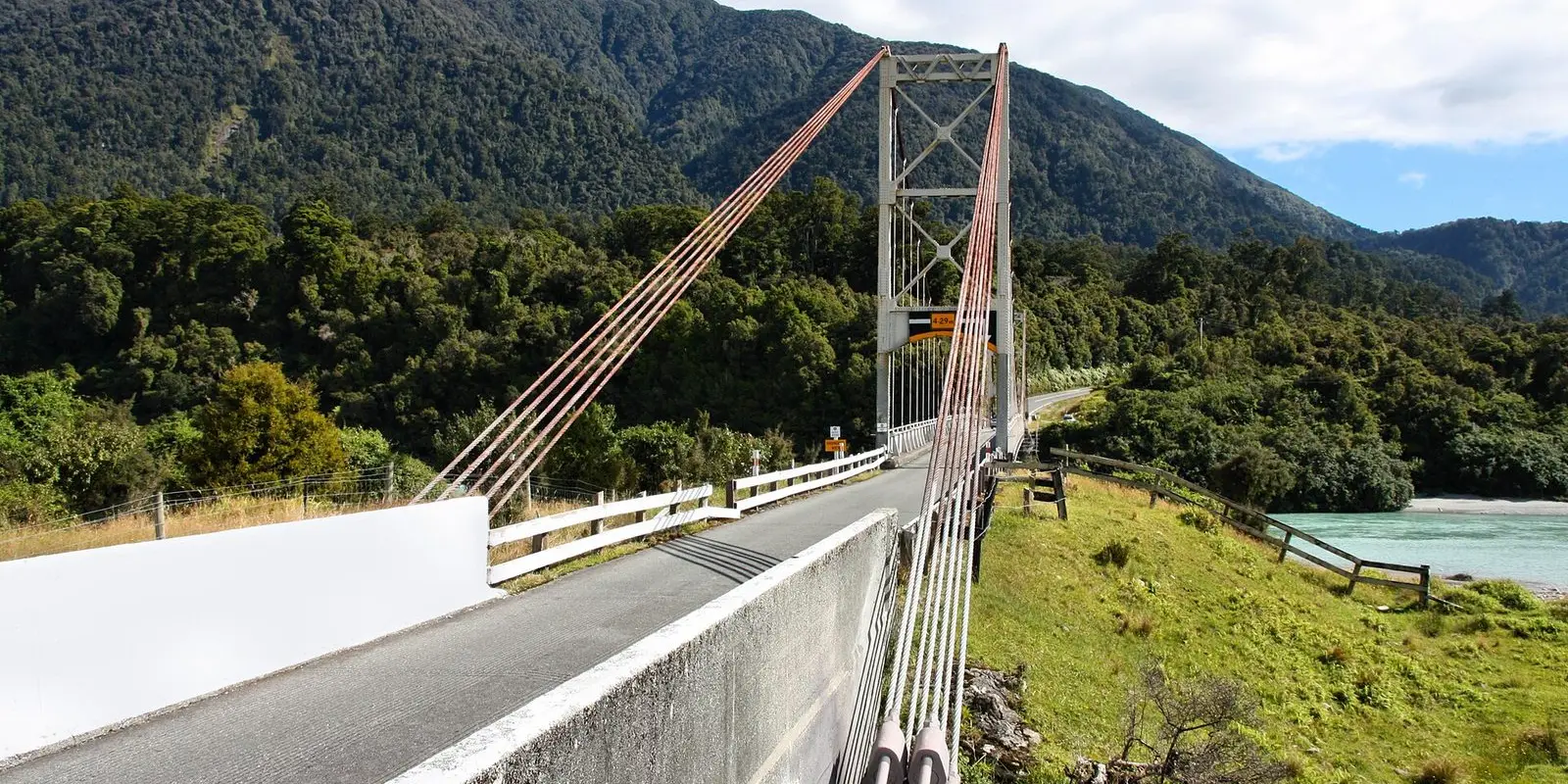
One-lane bridges are found on many New Zealand roads, including state highways. Signs warn you as you approach. The small red arrow shows which direction must give way: if the red arrow is on your side, you stop and let oncoming traffic cross first. If you have the bigger arrow and the road is clear, you can go, but slow down and check for oncoming traffic either way.
Unsealed (gravel) roads can be slippery. Keep left, slow down, and slow down further when another vehicle approaches, because dust cuts visibility and stones chip windscreens. Check your rental agreement too: some rental insurance excludes damage on unsealed roads.
Rail crossings: stop if red lights are flashing. At a stop sign, stop and only cross if no trains are coming either way. At a give way sign, slow down and be ready to stop.
Winter driving: snow and ice make mountain passes and shaded roads risky. If your rental company gives you snow chains, learn to fit them before you leave. Check MetService and NZTA traffic updates before you set off.
Fatigue and realistic drive times
New Zealand distances look short, but the roads go through mountains and hills and some are gravel, so they take longer than you expect. NZTA recommends the NZTA Journey Planner for realistic travel times. For a sense of scale, DOC gives 3.5 hours from Queenstown to Aoraki/Mount Cook National Park and 4.5 hours from Christchurch.
NZTA’s fatigue advice for visitors:
- Get enough sleep before you drive, especially after a long flight.
- Take a break every two hours.
- Share the driving if you can.
- Avoid driving when you would normally be asleep.
- If you feel sleepy, stop somewhere safe for a 15 to 30 minute nap, or find a bed for the night.
And do not drive while sightseeing. Pull completely off the road to look at the view, and never stop where there are no-stopping signs or dashed yellow lines.
Our 14-day South Island road trip is built around drive times that leave room for stops and short days.
Alcohol, drugs, phones and seatbelts
Alcohol (NZ Police):
| Driver | Limit |
|---|---|
| 20 and over | 250 micrograms of alcohol per litre of breath, or 50 mg per 100 ml of blood |
| Under 20 | Zero |
If a roadside test shows you are over the limit, you take an evidential breath test, and if confirmed you will likely be forbidden to drive for 12 hours. Police say the number of drinks that takes you over depends on your size, sex and food, and NZTA’s advice is that the limit is so low it is safest not to drink at all if you are driving.
Drugs: it is illegal to drive impaired by drugs, or with qualifying drugs in your system at a level that shows recent use, including some prescription medicines. Police list penalties of $200 and 50 demerit points for one qualifying drug, and $400 and 75 points for two or more.
Phones: you must not use a hand-held phone while driving, including to make or take a call. Texting on any phone while driving is illegal. The penalty is a $150 fine and 20 demerit points.
Seatbelts: everyone must wear one. Children under 7 must be in an approved child restraint; 7-year-olds use one if available, otherwise a seatbelt; children 8 and over use a seatbelt.
Fines and demerit points
NZTA’s speeding infringement fines depend on how far over the limit you were:
| Over the limit | Fine |
|---|---|
| Up to 10 km/h | $30 |
| 11 to 15 km/h | $80 |
| 16 to 20 km/h | $120 |
| 21 to 25 km/h | $170 |
| 26 to 30 km/h | $230 |
| 31 to 35 km/h | $300 |
| 36 to 40 km/h | $400 |
| 41 to 45 km/h | $510 |
| 46 to 50 km/h | $630 |
More than 40 km/h over can mean a 28-day licence suspension, and more than 50 km/h over can lead to charges of careless, dangerous or reckless driving. You may also get demerit points; NZTA says 100 or more within 2 years can mean a 3-month suspension.
Speed is also enforced by safety cameras, with notices issued by NZTA. In a rental, the notice goes to the company as the registered owner, and the rental agreement sets how it is passed on to you. Our car rental guide found that GO Rentals, for example, recovers unpaid toll notices plus an admin fee, so check your own company’s terms for fines.
If you are stopped by police, they will drive behind you with flashing lights. Pull over as soon as it is safe and wait in the car for the officer.
Before you set off
- Licence (and English translation if needed) in the car, every time.
- Read your rental agreement for gravel roads, ferries and fine admin fees.
- Plan with the NZTA Journey Planner and check road conditions on mountain passes.
- Build in a rest every two hours, and no long drive the day you land.
- Make sure your travel insurance covers rental vehicle excess, or buy excess cover.
FAQ
Can I drive in New Zealand with my overseas licence?
Do I need an international driving permit for New Zealand?
What side of the road do you drive on in New Zealand?
What happens if I get a speeding ticket in a rental car?
How many drinks can I have before driving in New Zealand?
Sources
Last checked 11 November 2026
- Visiting New Zealand · NZ Transport Agency Waka Kotahi
- Driving in New Zealand (booklet, 2026) · NZ Transport Agency Waka Kotahi
- Speeding: fines and penalties · NZ Transport Agency Waka Kotahi
- Demerit points · NZ Transport Agency Waka Kotahi
- Being safe: road rules and reasons · New Zealand Police
- Land Transport (Road User) Rule 2004, clause 4.2 (giving way) · New Zealand Legislation
- Aoraki/Mount Cook National Park (drive times) · Department of Conservation